
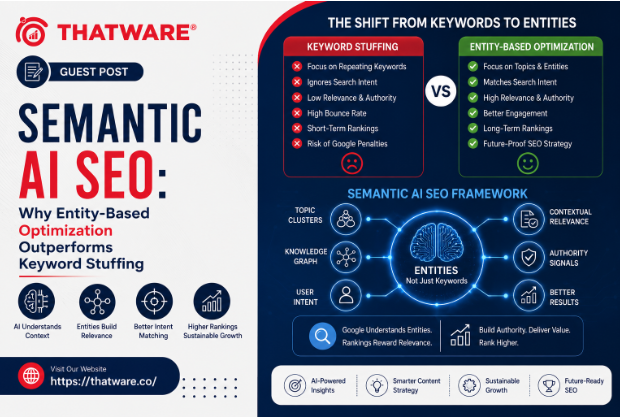
Keyword stuffing is a technique that most people in SEO consider long dead. And in the obvious forms — repeating the same phrase fifteen times in a paragraph, white-text-on-white-background keyword blocks — it genuinely is. Google’s spam filters catch it, penalize it, and have for years.
But there’s a more subtle form of keyword fixation that persists throughout the industry: treating optimization as primarily a keyword placement exercise. Choose terms, hit frequencies, distribute across headers and body text, monitor rankings for those terms. This isn’t stuffing in the egregious sense, but it reflects the same underlying mental model — that search optimization is about matching text strings rather than establishing semantic meaning.
Entity-based optimization starts from a fundamentally different premise. And the performance difference, in competitive search landscapes, has become hard to ignore.
Entities vs. Keywords: The Core Distinction
A keyword is a string of text. “Best running shoes” is a keyword. It has search volume, competition metrics, and click-through rate estimates. Traditional SEO is built around keywords as the fundamental unit of optimization.
An entity is a real-world object or concept that Google recognizes and tracks relationships between. “Nike Air Zoom Pegasus 41” is an entity — a specific product with known attributes, a manufacturer (Nike, which is itself an entity), a category (running shoes), use cases (road running, daily training), related entities (competing products, retail channels, professional endorsers), and a structured position in Google’s knowledge graph.
The difference in how Google evaluates pages that address keywords vs. pages that establish entity relationships is substantial and growing. A page that contains the text “best running shoes” many times is demonstrating keyword relevance. A page that establishes comprehensive entity relationships around running shoe selection — covering the relevant product entities, their differentiating attributes, use-case entities, and the relationships between them — is demonstrating semantic authority.
How Entity SEO Works in Practice
Semantic AI SEO services approach optimization by mapping the entity landscape around a topic before thinking about keyword placement. For a given content area: what are the primary entities (products, people, organizations, concepts)? What relationships between these entities does Google’s knowledge graph recognize? What does comprehensive coverage of this entity neighborhood look like?
This analysis produces a content specification that’s fundamentally different from a keyword brief. Instead of “include these terms at these frequencies,” it says “establish these entities, address these relationships, demonstrate this depth of understanding about how these concepts connect.” Content written to that specification naturally contains relevant keywords — but the keywords are evidence of semantic coverage, not the optimization goal.
The practical output is content that tends to rank for more queries than it was specifically targeting, because entity authority transfers across semantically related searches.
Topical Authority Through Entity Coverage
The concept of topical authority — which has become central to competitive SEO strategy — is essentially a domain-level entity coverage score. A domain that has published comprehensive, expert content covering the full entity landscape of a topic area is recognized as topically authoritative. A domain that has published keyword-optimized content around the same topic without establishing the entity relationships that define it is not — regardless of how much content it has published.
NLP SEO optimization company services help build topical authority explicitly by mapping what comprehensive entity coverage looks like for a domain’s subject area and systematically filling coverage gaps. This is fundamentally different from publishing keyword-targeted articles. It’s building the entity neighborhood that establishes domain expertise.
Structured Data as Entity Signal
Structured data markup is the most direct way to communicate entity information to search engines. Schema.org markup explicitly declares entities — “this is a product,” “this is a person,” “this is an organization” — and their attributes, making entity relationships unambiguous for crawlers.
Comprehensive structured data implementation isn’t just about rich results (though those are valuable). It’s about clarity of entity communication — ensuring that Google’s knowledge graph has the information it needs to accurately classify and position your content within the broader web of semantic relationships.
The brands that will dominate organic search over the next several years aren’t those with the most keyword-optimized content. They’re those with the most comprehensively mapped and communicated entity architectures. That’s what semantic AI SEO is building toward.